
Activating Nature Markets: The Role of Measurement and MRV
Nature markets - spanning carbon, biodiversity, and emerging ecosystem service credits -are widely seen as a critical mechanism to fund the transition to more resilient, low-emissions land use. However, their growth has been uneven, constrained by a fundamental challenge: the difficulty of measuring, verifying, and trusting nature-based outcomes at scale. As interest accelerates from corporates, financiers, and policymakers, robust nature measurement and MRV (Measurement, Reporting, and Verification) systems are becoming the key enabler that will determine whether these markets remain niche or unlock meaningful global impact.
At the heart of the challenge is the complexity of natural systems and the sheer scale of the measurement task across entire supply chains. Historically, measurement has relied heavily on field-based sampling, which, while accurate, is costly and difficult to scale. This has led to inconsistencies, limited transparency, and, in cases, less confidence in environmental claims.
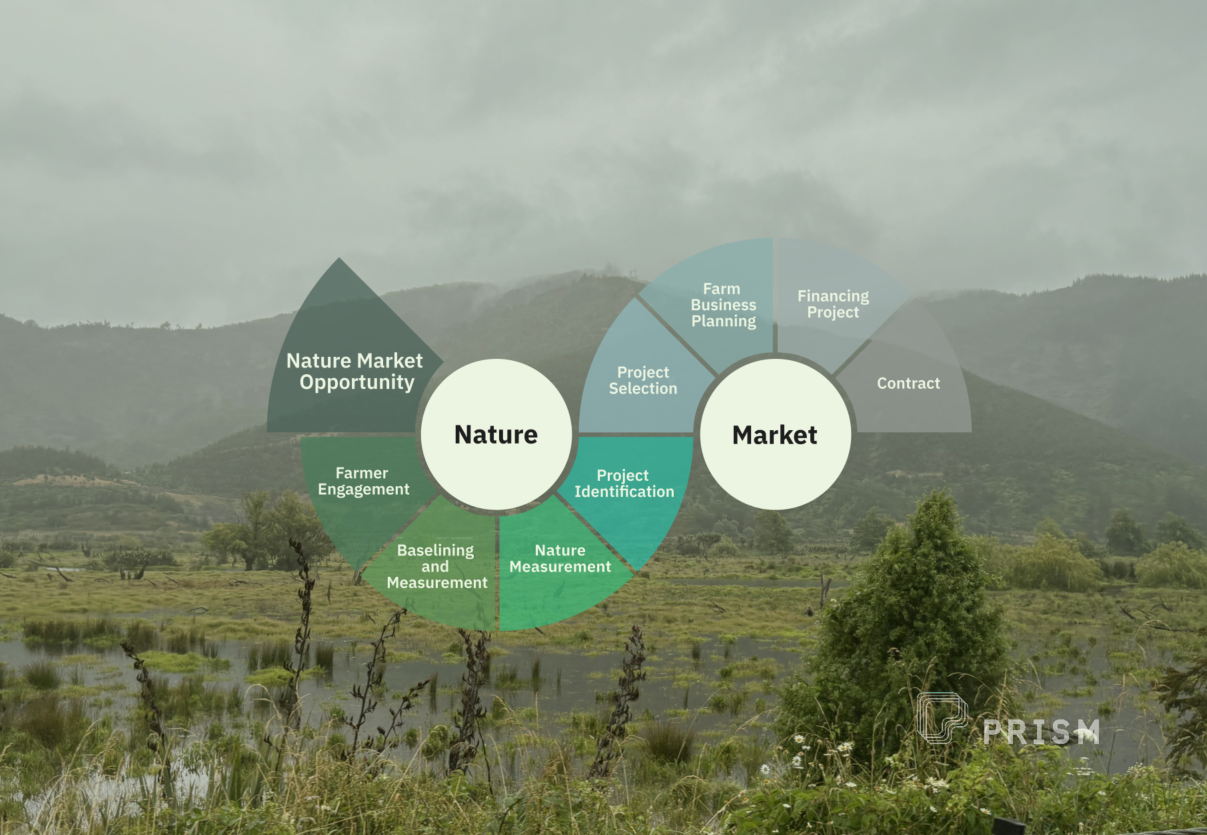
This is where advances in spatial data, remote sensing, and integrated modelling, such as those being developed by Prism, are reshaping what is possible. By combining sensor data with farm-level information and process-based models, it is now feasible to create continuous, spatially explicit representations of land use and environmental outcomes. This allows natural capital to be measured across entire landscapes rather than inferred from sparse samples.
In the carbon domain, this capability is transformative. Measurement of woody biomass, such as shelterbelts, riparian planting, and native regeneration, has traditionally been under-represented in carbon markets due to the fragmented and heterogeneous nature of these features. Our work at farm scale overcomes this by delivering consistent, repeatable annual carbon removal data using a combination of remote sensing, modelling and human verification.
However, carbon is only one part of the equation. There is growing demand for biodiversity credits and nature-positive reporting, driven by frameworks such as the Taskforce on Nature-related Financial Disclosures (TNFD). Yet biodiversity presents even greater measurement challenges, as it is multi-dimensional and not easily reduced to a single metric. Prism’s approach focuses on translating ecological complexity into practical, spatially derived indicators, such as habitat extent, condition, and landscape connectivity. By linking these metrics to livestock production areas, it becomes possible to quantify biodiversity outcomes in a way that is both scientifically credible and operationally scalable.
Deforestation monitoring is another critical component of nature markets, particularly in the context of supply chain assurance. Global markets increasingly require proof that commodities are sourced from deforestation-free landscapes. Prism’s capability to maintain an up-to-date, definitive farm boundary data, deforestation status within farms and track livestock movements over time enables transparent verification of deforestation claims, supporting access to premium markets and compliance with evolving regulations.
Despite these advances, significant challenges remain. One of the most persistent is additionality - the requirement to demonstrate that environmental gains would not have occurred without the intervention or incentive. In integrated farming systems like those Prism supports, where agroforestry, flexible grazing, and biodiversity enhancement are intertwined with productivity, it becomes difficult to separate “business-as-usual” from truly incremental change. If handled poorly, this could lead to over-crediting (undermining trust) or excessive conservatism (limiting farmer participation).
The opportunity lies in using spatial data, historical time series land-use insights, and system-level modelling to move beyond binary tests toward more nuanced, evidence-based assessments of genuine change. By lowering the cost and increasing the reliability of nature measurement, MRV systems can unlock new revenue streams for landholders, incentivise regenerative practices, and provide corporates with credible pathways to meet climate and nature targets.
Ultimately, activating nature markets will depend on building trust - trust that the outcomes being measured are real, that they are additional, and that they are sustained over time. Advances in spatial modelling, data integration, and MRV systems are laying the foundation for this trust. The next phase will be scaling these capabilities, aligning them with global standards, and embedding them into the everyday decision-making on farm. If successful, this will transform nature from an externality into a measurable, investable asset class - unlocking the capital needed to support a more sustainable and resilient future.